When a Canadian real estate data platform came to Metrics Rule, their content had a visibility problem. The platform — a rental market data tool built for property managers and appraisers — had strong product functionality but was leaving serious organic search traffic on the table. Their city-level market pages were not structured to rank, and their average position hovered around 17.6. Within one week of implementing SEO content templates I developed for them, total impressions nearly tripled. Here is how it happened.
The Client: A Rental Data Platform for Real Estate Professionals
This client operates a real estate data platform that provides rental market data, automated pricing analysis, and AI-powered reporting tools to property managers, appraisers, and real estate investors across Canada and the United States. Their platform gives professionals access to rent comparables, market trends, and branded client reports in one place.
The platform had real technical depth and a growing user base. What it lacked was an SEO content structure that matched the search intent of the professionals it served. City-level rental market pages — the type of content property managers actively search for when pricing a property or advising a client — were not built in a way that search engines could fully understand, index, or reward.
The Starting Point: Decent Traffic, Poor Visibility
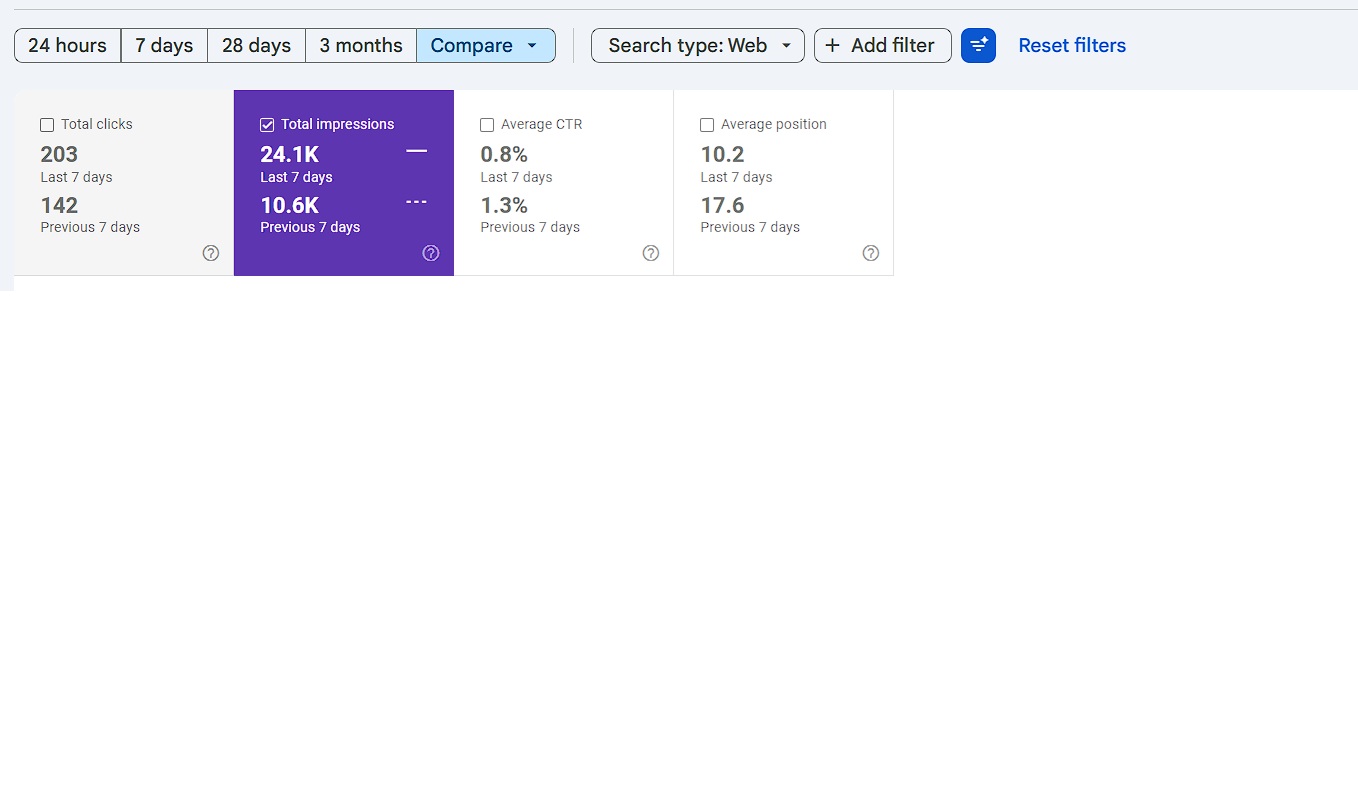
Before the template rollout, the platform’s Google Search Console data told a clear story. Over the trailing seven-day period, the site had recorded 10.6K total impressions and an average position of 17.6. A position in the high teens means the site was appearing on page two of search results — visible to Google’s crawlers, but effectively invisible to most users. Click-through rate sat at 1.3%, which is the ceiling you hit when rankings consistently land below the top five positions.
The opportunity was clear: the platform had data that property professionals actively search for, but the pages serving that data were not optimized to capture that demand. Content structure, heading architecture, semantic coverage, and schema markup all needed work.
The Strategy: Templates Built for Search Algorithms and Real Users
Rather than rewriting content page by page, the most scalable solution was to build a master SEO content template the client could apply across all their city rental market pages. This template was designed to satisfy multiple Google algorithms simultaneously — not just keyword matching, but natural language understanding, passage ranking, trust signals, and the Helpful Content Update’s demand for genuinely useful, people-first content.
Page structure and heading architecture
Each page template was built around a clear heading hierarchy that matched the actual questions the target audience types into Google. Every major section was written to be self-contained, so Google’s passage ranking system could surface individual sections independently in search results — not just the page as a whole.
Semantic coverage and topical completeness
The template was structured to cover the full range of subtopics a user searching for rental market data would expect to find on a single page. Covering all relevant subtopics in one well-organized page increases the page’s relevance across a broader set of related queries, which directly expands keyword coverage and generates more impressions.
Schema markup and structured data
The template included multiple schema types, each mapped to the appropriate section of the page. Certain schema types create eligibility for rich results in Google, which expands the visual footprint of a page in search results and typically improves click-through rates over time.
Trust signals for a professional audience
Because this platform serves professionals making real financial decisions, trust signals carry more weight than they would on a casual consumer site. The template included sections that demonstrated genuine expertise and transparency — not just raw data presented without context — which directly supports Google’s E-E-A-T evaluation criteria.
Internal linking and topical authority
Each city page template was designed to link to related pages across the site in a logical, structured way. This internal linking pattern reinforces the site’s topical authority on rental market analysis and helps Google understand how the pages on the site relate to each other.
The Results: One Week After Implementation
The client implemented the templates using their own development team — something that was possible because they had strong technical capability in-house. They applied the template structure to their existing pages, populated them with their own rental data, and launched the updates. The results appeared in Google Search Console within days.
Impressions nearly tripled in one week
Total impressions jumped from 10.6K in the previous seven-day period to 24.1K in the following seven days — a 127% increase in a single week. This jump signals that Google began indexing and surfacing the updated pages across a much broader set of queries. More impressions means the pages now appear for more keywords, which directly reflects the expanded semantic coverage built into the templates.
Average position improved by more than seven spots
Average position moved from 17.6 to 10.2 — crossing from page two into the bottom of page one. That threshold matters. Pages on page one receive measurable click traffic; pages on page two largely do not. As the updated pages continue to accumulate engagement signals over time, positions are expected to improve further.
Click volume grew 43% week over week
Total clicks grew from 142 to 203 in the same period. Click growth typically lags behind impression growth — rankings need time to stabilize before users start clicking at scale. The click trajectory is expected to accelerate as average positions push into the top five for the platform’s core queries.
The three-month trend confirms the breakout
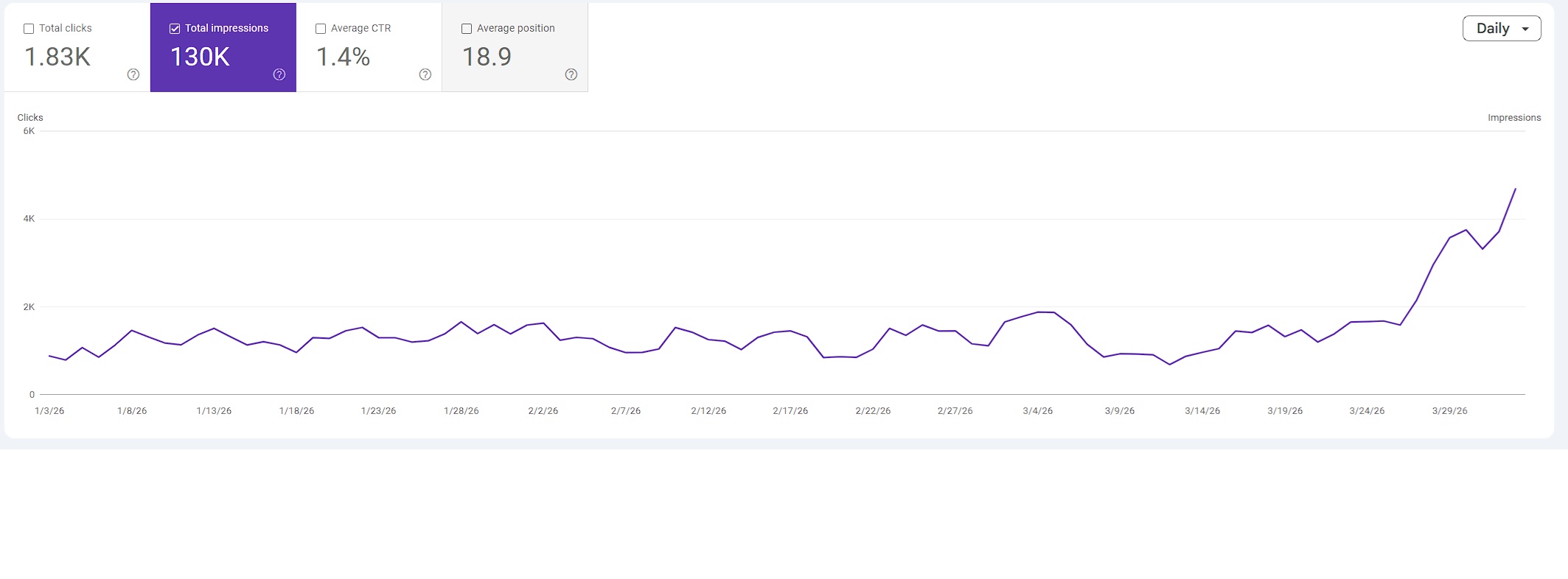
Looking at the broader impression chart puts the spike in context. Daily impressions were essentially flat from January through late March, bouncing between 1,000 and 2,000 per day. Immediately after implementation, impressions climbed to over 4,500 per day and continued rising. The platform recorded 130,000 total impressions over the three-month window, with the majority of that growth concentrated in the final two weeks.
Why the Results Came So Quickly
Results at this speed are not typical — and the reason they happened so fast for this client is worth explaining honestly. The platform already had indexed pages with existing crawl history and some domain authority. Implementing well-structured templates onto already-indexed URLs gave Google something substantively better to evaluate, and the algorithm responded quickly.
The second factor was the client’s technical capability. Because their team could implement the templates directly and accurately, there was no delay between the strategy being finalized and the changes going live. Clients without that in-house technical knowledge would typically need me to produce the actual page content, not just the template framework. The template did exactly what it was designed to do, in the hands of a team that knew how to use it.
What This Means for Similar Businesses
If your website has pages that contain real data or genuine expertise but those pages are not structured for search, this kind of result is achievable. The gap between what your content covers and what Google can understand about your content is often larger than it looks — and closing that gap with the right content architecture can move rankings fast.
For businesses that do not have a technical team to implement templates independently, the process looks slightly different. I build not just the template structure but the actual page content, populated with your data and tailored to your audience. The outcome — broader keyword coverage, stronger rankings, and more organic impressions — is the same. The path to get there is just more hands-on.